The Importance of Wire Cores in Eyewear

Updated: Sep 12
Why Have The Temple Pins?
Not every eyewear material needs a temple pin. Injection-molded plastic (PC/TR) frames are formed in a mold at high heat and come out rigid and self-supporting. They hold their shape on their own. However, injection-molded Cellulose Propionate (CP) is an exception. Both CP and injection acetate temples require a wire core.
Acetate is different. Cellulose acetate, or simply acetate, has a relatively low melting point and softens with heat. That's actually part of what makes it so appealing — an optician can warm the temples slightly and bend them precisely to fit a customer's face. But that same quality means the material needs internal support. Without a metal core wire running through the temple, an acetate arm would warp, bend unevenly, or crack over time.
The core wire solves this. It gives the temple its backbone — structural stability during wear, and the flexibility needed for professional adjustments. Where that wire exits the acetate at the very tip of the temple, the exposed metal end is what we call the temple pin.
It exists because the material requires it. But what you do with it is entirely a design choice.
Most People Never Notice It — Until They Do
Take a look at these two frames. Same shape. Same acetate color. Same temple length.

The difference is in the wire core. One is hidden inside, while the other is shown outside. Neither is wrong. But they feel different. They say something different.
That's the point.
The wire core sits right where the frame meets the ear — one of the most consistently visible parts of a frame in photos, in person, and in close conversation. For most brands, it's treated as an afterthought. A default finish was selected without much consideration. But for the brands that get it right, it becomes one of those small things that customers notice without knowing why they noticed it. A detail that makes the frame feel more considered, more complete.
This is exactly the kind of place where a brand can do something different. Something that's quietly theirs.
Insider View: How The Wire Core Colors Are Actually Made
Having been in the eyewear industry for nearly 20 years, I have accompanied many brands as they grow. One thing I’ve learned is that the details most brands overlook are usually the ones with the most room to differentiate. The wire core color is one of them.
There are several ways to achieve color on a metal pin, and the process behind each one produces a meaningfully different result — in appearance, in durability, and in cost. Here's how they actually work.
Standard Electroplating
In standard electroplating, the metal pin is submerged in a chemical bath, and an electrical current is passed through the liquid. This causes metal ions — gold, silver, nickel — to bond onto the surface of the pin, building up a thin metallic layer.
The process is relatively fast and cost-efficient. The result is a clean, consistent metallic finish: classic gold, bright silver, gunmetal. For most production runs, it performs well. The tradeoff is durability — the coating layer is thin, and with extended daily wear, exposure to sweat, or regular friction, it can eventually show wear.
For contemporary brands at accessible to mid-range price points, standard electroplating is a solid, reliable choice.
IP Vacuum Plating
IP plating — ion plating — is a fundamentally different process. The pin is placed inside a vacuum chamber. Metal is vaporized, and the ions are accelerated onto the pin surface at a molecular level, bonding with the base metal rather than simply sitting on top of it.
The result is a coating that is dramatically harder and more adhesion-resistant than standard plating. Color consistency across large production batches is tighter. The finish holds up against sweat, daily friction, and time in a way that standard plating simply doesn't match.
Before plating, the pin surface can also be laser-engraved — a brand name, a logo mark, a small design element — and the plating will follow the engraving perfectly, leaving a subtle, precise brand detail embedded in the finish.
IP plating costs more. But the gap between a standard plated pin and an IP plated one is something you can see and feel immediately. For brands building toward a premium or quiet luxury positioning, it's the right process for this detail.
Paint Coating
Where electroplating is limited to metallic tones, paint coating opens the spectrum entirely. Any color is achievable — matte black, deep burgundy, forest green, warm white, or a color pulled directly from your brand palette.
The application process involves spraying a specialized coating onto the pin surface and curing it at a controlled temperature. The result has a different surface quality than plating — less metallic, more graphic — but executed well, it can look extremely intentional. A matte-painted pin that coordinates with the acetate color, or deliberately contrasts it, creates a visual coherence that most brands never explore.
Paint coating is also a smart budget move. For brands where IP plating isn't justified at the price point, a well-executed painted pin still delivers something distinctive.
We have recorded a series of metal colorways shown in the shorts.
Different Processes, Different Brand Positions
The reason these processes matter beyond the technical is that each one maps to a different place in the market.
IP vacuum plating with laser-engraved branding is a premium investment. It's for brands where the quality of every component needs to justify a higher retail price, where customers are paying attention to materials and finish, and where the subtle presence of a brand mark on the hardware is more powerful than a logo on the lens.
Standard electroplating covers the contemporary and accessible premium space well. The finishes are clean and familiar — gold on tortoise, silver on clear, gunmetal on black — and they work because they're right, not because they're safe.
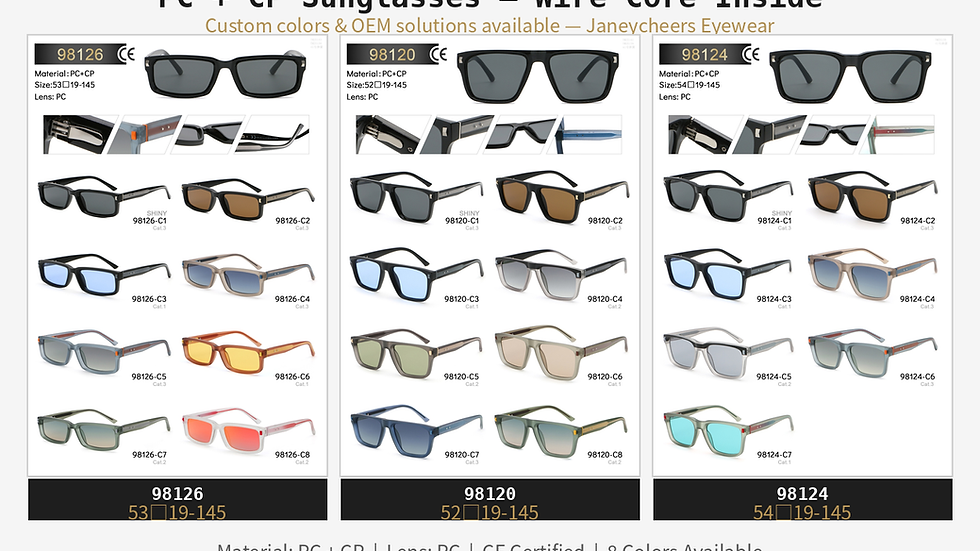
Paint coating belongs to the brands with a strong color identity. If your brand has a signature palette, a defined aesthetic, a point of view that extends to every touchpoint, the pin is another place to express it. Most brands don't take this option. Which is exactly why it's worth considering. For instance, we currently launch a series of highly cost-effective PC front CP temples with paint-coated wire cores inside. See the examples below. Contact us for the full catalog.
Building a Brand That Stands Out in the Details
Julius Tart Optical has used the same triple-pin rivet design for decades. Cutler & Gross has their signature hardware finish. These weren't accidents. They were early decisions, held consistently, that compounded over time into something recognizable.
You don't need their history to think this way. You just need to make the decision before your first sample — not after.
Every Brand Is Different. Your Product Should Be Too.
There's no single right answer for pin color or finish. The right answer is the one that fits your brand — your positioning, your customer, your aesthetic language.
What I've found, after years of working with brands at every stage, is that the ones who build something lasting are usually the ones who ask these questions early. Not "what's the default?" but "what's ours?"
At Janeycheers, we don't believe in one-size-fits-all production. We believe in understanding where your brand is going before we talk about how to make it. Whether you're launching your first collection or expanding an existing line into eyewear, we'll work with you to identify the details that will make your product feel like yours — and help you execute them precisely.
Your vision. Your brand. We'll help you build it right.
JaneyCheers Eyewear, always premium, always a reliable eyewear solutions provider behind the scenes.


Comments