Best Lens Options in Custom Sunglasses: An Insider's View for Brands and Wholesalers
- JaneyCheers
- Dec 20, 2025
- 5 min read

When brands search for “best lens options in custom sunglasses," they mostly find some consumer guides on color charts, basic polarized explanations, and lifestyle tips. Useful, but thin, if you are responsible for a product line, a budget, and a supply chain in private label sunglasses or OEM sunglasses projects.
From a B2B angle, lens choices sit where product strategy, end‑user environment, and manufacturing stability meet. We look at custom sunglasses lenses from that junction: less “what exists”, more “what works for our customers, their pricing, and better operations” in private label sunglasses, eyeglasses, and OEM &ODM custom sunglasses.
1. Begin with users and where they wear
Before discussing lens technologies, define who will wear the sunglasses and where. The same polarized lens behaves quite differently in an air‑conditioned office, on a ski slope, or in a salty seaside stall.
Two basic questions help:
Who are your core customers?
Tourists buying on impulse, repeat buyers in optical stores, performance users like anglers or surfers, or online fashion shoppers all trade off price, durability, and performance in different ways.
In what environments will the products sit and be used?
Indoor malls, street markets, coastal shops, hot window displays, or pure e‑commerce each bring their own mix of temperature, humidity, UV, and even air salinity that will age lenses at different speeds.
A real case in Malaysia
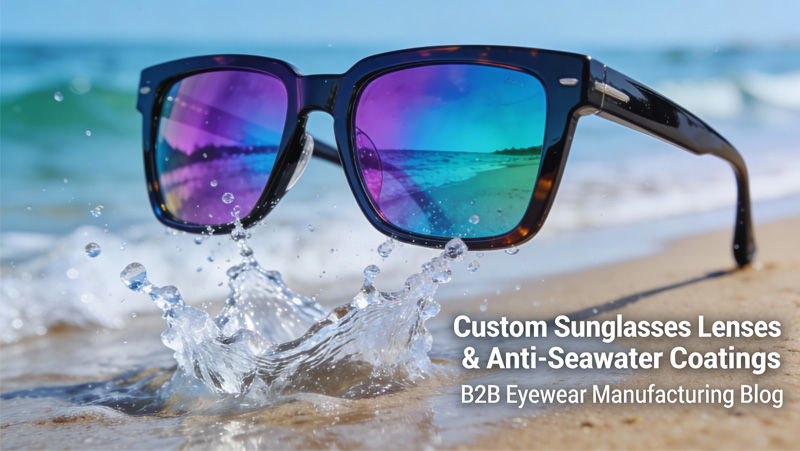
Consider one case. A Malaysian client runs a year‑round seaside shop and launched a custom sunglasses line. Stock sits close to the sea, exposed to humid air, salt, and strong sunlight. Under these conditions, anti‑seawater coating is not an optional upgrade but a basic filter: without it, mirror and AR coatings corrode, peel, and lose gloss on the display rack long before the product’s design life.
Start from this end‑user reality, and the lens discussion naturally moves from generic features to precise functional requirements in your custom sunglasses lenses.
2. CSPL versus TAC: structure before slogan
Lens materials and constructions continue to shift. Most public guides still revolve around TAC polarized lenses, but composite PC‑based solutions such as CSPL are designed to tackle some of TAC’s weaknesses in harsher use.
In simplified form:
TAC laminated polarized lenses
Structure: multiple TAC layers laminated around a polarizing film.
Strengths: proven, cost‑effective polarization and decent clarity for many everyday uses.
Trade‑offs: the stacked structure can be more vulnerable to environmental stress and delamination if lamination or coatings are not tightly controlled.
CSPL‑type composite lenses based on PC injection
Structure: polarization integrated into a PC‑based compact lens body.
Strengths: more stable internal structure, lower water absorption, and better resistance to heat and stress, which supports more predictable coating behaviour over time.
The difference becomes more visible once you add demanding surface treatments. Mirror, hydrophobic, and anti‑seawater coatings test the bond between layers and the substrate under salt, sweat, heat, and cleaning cycles. In that context, a stable PC‑composite base often gives coatings a safer home than a multi‑layer laminate, where every interface is a potential weak link if process control wobbles.
There is no universally “best” material. The rational question is simpler: for this user, in this environment and price band, which construction is robust enough without overspending in a private label or OEM sunglasses lens guide?
3. Salt, seawater, and why coatings fail
Saltwater and salty air are the quiet killers of lens coatings. They are mentioned less often than UV, but in coastal retail and water‑related use, they destroy surface treatments quickly.
Mechanically, two things matter:
Salt and minerals find their way into micro‑gaps between the coating stack and lens surface, slowly weakening adhesion and producing spots and peeling.
Cycles of salt exposure, drying, and cleaning add micro‑scratches and accelerate the breakdown of mirror and anti‑reflective layers.
For projects like the Malaysian seaside range, an anti‑seawater or upgraded hydrophobic/oleophobic coating reduces this damage: coatings adhere better, lenses survive longer on the shelf, and products keep their visual integrity in front of tourists and locals alike.
In these settings, pairing a PC‑composite polarized base (for structural stability) with such coatings is a business decision, not a technical indulgence. It costs more than a basic TAC polarized lens, but over time, fewer complaints and fewer write‑offs for your business.
4. Colour consistency: from excuse to specification
Sooner or later, most brands face the same irritation: the “same” lens colour in a later batch is not quite the same. The standard reply is that each coating batch has unavoidable colour variation. Technically true; commercially incomplete.
For B2B buyers, the questions are sharper:
What degree of variation can your channels and customers accept?
Is variation random, or held within a defined, measurable window?
Underneath sit three basic stability issues:
Process: Are coating and tinting parameters and recipes controlled, or adjusted by judgment call each time?
Measurement: Does the lens factory quantify colour and transmission, or rely mainly on visual checks under shifting conditions?
People: Are trained operators following fixed procedures, or is high turnover and improvisation the norm?
B2B buyers cannot remove variation, but they can contain it:
Concentrate lens purchasing for repeated key colours and functions in one qualified supplier, instead of scattering orders.
Specify lens suppliers for those critical colours in OEM/ODM contracts, rather than allowing frame factories to switch sources freely based on availability.
Keep master references—physical samples and, where possible, measured colour and VLT ranges—and approve new batches against them, especially for signature tints.
The tone of the conversation then moves from “this is unavoidable” to “this is the tolerance, and this is how we manage it” in your private label eyewear and custom sunglasses lenses.
5. Turning lens choices into a repeatable system
For custom sunglasses and private label sunglasses, lenses are not just components; they are part of a system, defined by how you tailor functions, environments, materials, and suppliers in a way that can be repeated season after season.
In practice, that system looks like:
One clear lens ladder per product family, tied to customer groups and sales environments.
Defined material and construction rules—for example, where a CSPL‑type PC composite is justified, and where a TAC polarized solution is sufficient.
Named lens suppliers and minimum documentation standards for key colours and coatings, particularly when anti‑seawater or other demanding treatments are involved.
Even with this structure, there is always a gap between specification and reality. That is where a hands‑on manufacturing partner earns their keep.
A good B2B custom sunglasses supplier will help to find the best lens options in custom sunglasses.
Relate lens options to actual users and environments instead of simply reciting catalogues.
Turn your requirements into simple routines: sample approval, master references, and basic batch checks on important lens colours and coatings.
Protect small runs and tests with the same care as larger orders, so even trial quantities look and feel consistent on the shelf for your private label sunglasses lines.
Over time, that combination—a clear system on your side and disciplined execution on theirs—turns lens choices from a series of one‑off decisions into something quieter but more valuable: predictable quality and a supply chain you can trust to behave the same way next season as it did this one, across your OEM sunglasses and private label eyeglasses collections.
We are JaneyCheers Eyewear. We share, empower, and we grow together.


Comments